The Solar Buyer's Checklist
This checklist is for homeowners who are thinking about solar panels and want to go into the process with their eyes open. Work through it before, during and after you collect quotes, and you will know what to ask, what to get in writing and which warning signs mean you should walk away.
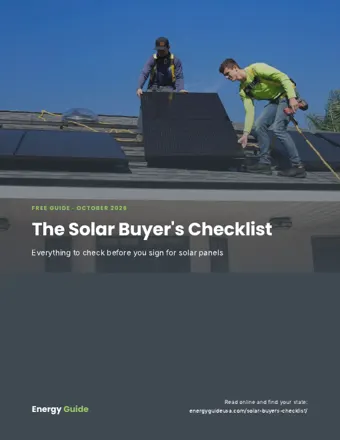
Free PDF to print and keep
The same guide as a 347 KB PDF, with checklists you can tick off by hand.
First, an honest reality check for 2026
Solar is a bigger decision than it was a year ago. The federal Residential Clean Energy Credit, which took 30% off the cost of a system you owned, ended for systems installed after December 31, 2025. The IRS treats the cost as incurred when installation is completed, so paying a deposit in 2025 does not qualify a system finished in 2026. If you bought before then, see our guide Solar After the Federal Tax Credit for what is still left.
Solar can still make sense, especially where electricity is expensive. The US average residential price was 18.19 cents per kWh for January to July 2026, according to the US Energy Information Administration (EIA), up from 17.01 cents a year earlier, and some states pay more than 30 cents. But solar does not pay for everyone. It tends to be a poor fit when:
- Your roof is heavily shaded, faces mostly north, or will need replacing within a few years.
- Your electricity is cheap, or your utility pays little for the power you send back to the grid.
- You expect to move within a few years and are not sure a buyer will value the system.
- You would have to borrow at a high interest rate, which can wipe out the savings.
Every home is different, so any savings figure you see is an estimate, and your results will be your own.
Before you ask for quotes
A little homework makes every quote easier to judge, and it stops a salesperson from setting the terms of the conversation.
- Gather 12 months of electric bills, and note your total kWh used for the year (see How to Read Your Electric Bill).
- Work out what you really pay per kWh: total bill divided by kWh used, averaged over the year.
- Find out how your utility credits the power you export: full net metering, net billing at a lower rate, or something else. Ask your utility or check its website.
- Check whether your utility has time-of-use rates, and whether going solar would move you onto a different rate plan.
- Know the age and condition of your roof. If it needs replacing within about 5 to 10 years, consider doing that first.
- Look at shade from trees, chimneys and neighboring buildings across the day and through the seasons.
- Check homeowners association rules and any local permit requirements.
- Look up state and local incentives on DSIRE (dsireusa.org) and your state energy office website.
- Think about future changes in your electricity use, such as an electric vehicle or a heat pump.
- Decide roughly how you would pay: cash, a loan, a lease or a power purchase agreement (PPA).
- Run your own rough numbers in our Solar Cost Calculator so you have a baseline before anyone pitches you.
Checking the installer
The company you pick matters as much as the panels. A good installation lasts for decades; a poor one can leak, underperform or leave you with no one to call when something goes wrong.
- The company holds the contractor or electrical license your state requires. Verify the number on your state licensing board website.
- They carry general liability and workers' compensation insurance, and will show you certificates.
- Someone on the project holds a current NABCEP certification, or the company can explain how its installers are trained.
- They have been in business long enough to stand behind a workmanship warranty, and have a local office or service team.
- You know whether they use their own crews or subcontractors, and who you call after installation.
- You have checked complaints with the Better Business Bureau and your state attorney general's consumer protection office.
- You have read recent reviews, paying attention to how problems were handled, not just star ratings.
- You have asked for two or three references from customers whose systems are at least a few years old.
Checking the proposal
Get at least three written quotes. Our guide How to Compare Solar Quotes Like for Like shows how to line them up properly. At minimum, each proposal should state:
- System size in kilowatts (kW DC), the number of panels and their wattage.
- The type of inverter (a central string inverter, microinverters, or a string inverter with optimizers).
- Estimated production in kWh for the first year, and the assumptions behind it (shade, roof direction, tilt, yearly degradation).
- What share of your annual use the system is expected to cover.
- Total price before any incentives, and the price per watt (total price divided by system watts).
- Exactly which incentives are assumed. For a system you own and install in 2026, there should be no federal tax credit in the figures.
- The electricity price and yearly price increase used in any savings projection. Ask to see the numbers with no increase at all.
- Whether permits, utility interconnection, roof work, electrical panel upgrades and monitoring are included.
- Battery details if one is offered: usable capacity (kWh), power (kW), and which circuits it backs up in an outage.
If a 2026 quote for a system you would own still subtracts a 30% federal tax credit, it is out of date or misleading. Ask for a corrected quote in writing, and treat it as a warning sign about the company.
Checking the contract
The contract, not the sales presentation, is what you can rely on later. Read every page before you sign, and do not sign on a tablet you cannot review in full.
- The total price, payment schedule and what triggers each payment. Avoid paying most of the price before installation.
- A start and completion timeline, and what happens if it slips.
- The equipment listed by type and size, with a clause covering substitutions only with your written approval.
- Workmanship warranty (what it covers and for how many years), separate from the equipment warranties.
- Roof penetration or leak warranty, and who fixes roof damage.
- Who handles permits, inspections and the utility interconnection application.
- Whether there is a production guarantee, and how any shortfall is paid.
- Who pays to remove and reinstall the panels if your roof needs replacing.
- Your cancellation rights. A sale made in your home is often covered by the Federal Trade Commission's Cooling-Off Rule, which generally gives you until midnight of the third business day to cancel; some states give more.
If you are financing, leasing or signing a PPA
Loans
- Compare the loan amount with the cash price. The Consumer Financial Protection Bureau (CFPB) has warned that some solar loans add "dealer fees" that raise the amount borrowed well above the cash price.
- Ask for the APR, the total of all payments, and any fees, in writing.
- Check whether the payment jumps after a set period unless you make a large lump-sum payment. Many older loans assumed you would pay down the loan with a tax credit that no longer exists for 2026 installations.
- Compare the offer with a home equity loan or credit union loan.
Leases and PPAs
With a lease or PPA, a company owns the system and you pay a monthly amount or a price per kWh. There is little or no upfront cost, but you will not own the equipment, and the long contract has to be planned around.
- The annual escalator: how much your payment or price per kWh rises each year, over the full term.
- The total you would pay over the contract, compared with your current bills.
- What happens if you sell your home: transfer requirements, buyer credit checks, or a buyout.
- Whether the company files a notice (often a UCC filing) on your property records, and how it is handled at sale.
- Who maintains and insures the system, and what happens at the end of the term.
- Whether any tax benefit the company receives is reflected in your price. Ask directly.
Red flags that mean slow down or walk away
- "Free solar," "government program" or "no-cost" claims. Someone always pays.
- Pressure to sign today to lock in a price or incentive that is "about to expire."
- A salesperson who will not leave a written quote, or who asks for your utility login.
- Savings figures with no explanation, or that assume steep yearly electricity price increases.
- Promises that you will have no electric bill at all. Most grid-connected homes still pay a monthly connection charge.
- Large deposits before permits are filed.
A reputable installer will be happy to give you time. If the offer disappears when you say you want to compare quotes, that tells you what you need to know.
After installation
- The local inspection has passed, and you have a copy of the final permit sign-off.
- Your utility has given permission to operate. Do not switch the system on before then.
- Monitoring is set up, and you know how to see daily and monthly production.
- You have copies of every warranty, the final as-built drawing and the interconnection agreement.
- Your first few bills show the solar credits correctly. Compare the production with the proposal's estimate after a full year.
- You have told your homeowners insurance company about the system.
- You have noted the date for checking production each year. Panels typically lose around 0.5% of output a year, according to federal lab research, so a sudden larger drop is worth a service call.
Example: a quick sense check on one quote
Say a quote offers an 8 kW system for $28,800, with a first-year production estimate of 10,400 kWh. The price per watt is $28,800 divided by 8,000 watts, or $3.60, which is close to the 2025 national median price of around $3.60 per watt that Lawrence Berkeley National Laboratory found for homeowner-owned systems before incentives. The production estimate works out at 1,300 kWh per kW per year, which is plausible for a sunny, unshaded roof in many parts of the country but would be optimistic for a shaded one. These are illustrative numbers only; your quote, roof and location will differ.
Next steps
- Solar Cost Calculator: get a baseline estimate for your home.
- Find your state: local prices, rules and incentives.
- How to Compare Solar Quotes Like for Like
- Request free quotes: we reply within 24 hours.
More free guides
Reviewed October 2026. General information, not financial, tax or legal advice; results are individual. How we research our guides.